
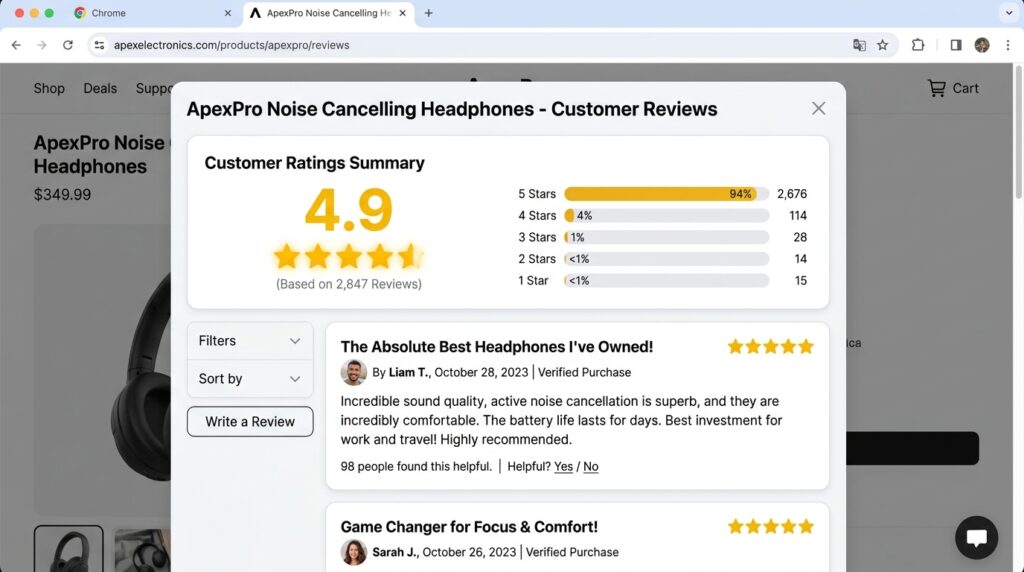
The customer dashboard looks reassuring.
Net Promoter Score is rising. Satisfaction ratings remain high. Complaint volumes are stable. The latest feedback summary contains several positive comments.
Leadership concludes that the customer experience is improving.
Yet customer behaviour tells a less comfortable story.
Some customers do not renew. Others reduce their use of the service or move part of their business elsewhere. Prospective customers abandon journeys before completing them. Complaints marked as resolved recur in different forms.
The score is strong, but customer value is weakening.
This does not necessarily mean the score is wrong. It may accurately represent what a particular group of customers said in response to a particular question at a particular moment.
The danger begins when the organisation interprets that score as proof of the health of the entire customer relationship.
A rating is a signal. It is not the complete reality.
Different scores answer different questions
Customer metrics are frequently discussed as though they are interchangeable.
They are not.
A customer satisfaction score generally asks the customer to evaluate a particular product, service or interaction.
A customer-effort measure examines how easy or difficult it was to accomplish something.
Net Promoter Score asks about the likelihood of recommending the organisation, product or service.
Each measure can provide useful information. But none of them directly tells management:
- Whether the customer will return.
- Whether they will renew.
- Whether they increased or reduced their business.
- Whether the relationship is profitable.
- Whether they encountered a failure elsewhere in the journey.
- Whether they have already begun considering another provider.
- Whether a service issue created financial or reputational exposure.
- Why customers who never completed the process disappeared.
A high satisfaction score means customers reported satisfaction with whatever the question asked them to evaluate. It should not automatically be translated into loyalty, retention or revenue security.
The first step towards better measurement is to stop asking one metric to answer questions it was never designed to answer.
The score only represents the people who were measured
Every customer score has a population behind it.
Who received the survey?
Who was able to complete it?
Who chose to respond?
Who was excluded because they did not reach the survey trigger?
These questions are as important as the final rating.
Imagine that a survey is sent only after a customer successfully completes a purchase. It may provide a valid view of customers who finished the journey.
It tells the organisation very little about those who:
- Abandoned the application.
- Could not reach the business.
- Failed an onboarding step.
- Received a quotation but never proceeded.
- Encountered an error before completion.
- Left before becoming formally registered.
The organisation may report excellent post-purchase satisfaction while losing substantial demand earlier in the journey.
This is a form of survivorship bias: the feedback system hears from customers who made it through the process while excluding many of those for whom the process failed.
The survey result may still be accurate. The claim made from it may not be.
Non-response is not neutral
Most customers invited to complete a survey do not respond.
The respondents are therefore a subset of the wider customer population, and they may not represent everyone equally.
Some customers respond because they had an exceptionally good experience. Others respond because they are angry. Some are comfortable completing surveys, while others ignore them regardless of how they feel.
The direction of non-response bias is not always predictable.
It would be incorrect to assume that everyone who remains silent is secretly dissatisfied. It would be equally incorrect to assume that non-respondents feel the same way as respondents.
This is why a customer score should always be considered alongside:
- The number of customers invited.
- The number who responded.
- The response rate.
- The channels through which responses were collected.
- The characteristics of respondents and non-respondents.
- The journey stages represented.
- Any groups systematically missing from the sample.
A score without its response context can create more certainty than the underlying evidence supports.
Timing shapes the answer
Customer perception changes over the course of a journey.
A customer may be pleased with a friendly employee immediately after an interaction but later discover that the promised outcome did not occur.
Another customer may feel frustrated during a difficult process but become satisfied after an effective recovery.
A survey sent immediately after contact captures an immediate reaction. One sent after delivery captures something different. A relationship survey conducted months later asks the customer to consider a broader experience.
None of these timings is universally correct. The right moment depends on what the organisation needs to understand.
The mistake is to collect feedback at one convenient point and interpret it as a complete assessment of the relationship.
Management should be clear about whether it is measuring:
- An individual interaction.
- Completion of a process.
- Delivery of an outcome.
- Recovery from a failure.
- The wider relationship.
- Continued value over time.
If the survey is sent before the customer has experienced the full result, the score cannot reliably represent what happened afterwards.
Averages can disguise important differences
An overall rating compresses many different customer experiences into one number.
That simplicity makes the score easy to communicate. It can also conceal where the greatest risks sit.
A high average may contain:
- Excellent scores from one branch and weak scores from another.
- Strong results among new customers and declining results among long-standing ones.
- Positive ratings for employee courtesy but poor ratings for process reliability.
- High satisfaction among customers who received standard service and frustration among those with complex needs.
- Strong transactional feedback alongside weakening renewal or repeat-purchase behaviour.
The overall score may remain stable while a commercially important customer group deteriorates.
I therefore want to see more than the average.
I want to know:
- How widely do scores vary?
- Which customer groups are missing?
- Where in the journey were the scores collected?
- Which branches, channels, products or processes produce weaker outcomes?
- Are changes broad-based or driven by a small segment?
- What do the comments reveal beneath the number?
- What did customers do after giving the rating?
An average can indicate direction. Diagnosis requires disaggregation.
The target can change the behaviour
Customer metrics become risky when they shift from learning tools to performance trophies.
Once a score becomes a prominent target, employees and managers naturally become attentive to how it is produced.
This does not mean that every organisation deliberately manipulates customer feedback. It means that incentives can influence behaviour, sometimes in subtle ways.
Employees may:
- Invite only visibly satisfied customers to participate.
- Tell customers that the rating affects them personally.
- Explain which score is considered “good.”
- Resolve complaints informally so that they do not enter the system.
- Delay sending surveys after difficult interactions.
- Focus on improving the number rather than the underlying experience.
- Pressure teams to remove inconvenient feedback from reporting.
Even without direct manipulation, the organisation may gradually design its measurement system around protecting the score.
Questions become safer. Difficult customer groups are excluded. Negative comments are explained away. Reports emphasise positive movement while recurring operational problems receive less attention.
The metric stops being a window into reality and becomes an image the organisation feels compelled to maintain.
A high score does not prove that revenue is protected
Customer ratings and commercial outcomes are connected, but the relationship is not automatic.
A satisfied customer may still leave because:
- A competitor provides better value.
- Their needs have changed.
- Switching is easy.
- The category matters too little to inspire loyalty.
- They were satisfied with one interaction but disappointed elsewhere.
- They have no immediate reason to buy again.
- The organisation failed to remain relevant.
- Price or convenience outweighs their positive experience.
A dissatisfied customer may also remain because alternatives are limited, switching is difficult or the relationship is contractually locked in.
Retention alone is therefore not perfect evidence of loyalty, just as satisfaction is not perfect evidence of retention.
The organisation must examine how reported experience relates to actual behaviour.
Do customers who give higher ratings renew more often?
Do they purchase again?
Do they increase their engagement?
Do they make referrals?
Do low-scoring customers leave—and, if not, why do they remain?
Does effective service recovery change later behaviour?
Which operational failures have the greatest effect on customer value?
Until customer feedback is connected to these outcomes, leadership cannot confidently describe a strong rating as evidence of protected revenue.
Complaints and survey scores reveal different populations
Formal complaints are another source of false reassurance.
A low complaint rate may indicate that customers encounter few problems. It may also mean that complaining is difficult, customers do not expect a useful response or dissatisfied customers prefer to leave quietly.
Similarly, complaint data represents customers who chose to speak. Survey data represents customers who chose to respond.
Neither population automatically represents everyone.
A more complete view considers:
- Survey respondents.
- Customers who complained.
- Customers who experienced service recovery.
- Customers who abandoned the journey.
- Customers who became inactive.
- Customers who did not renew.
- Customers who reduced their business.
- Customers who left without stating a reason.
The most commercially significant customer may be the one whose voice never enters a feedback report.
Conversations add context—but are not automatically superior
Direct customer conversations can reveal detail that a rating cannot.
Customers may explain the delay that nearly caused them to leave, the instruction they found confusing or the employee who rescued a difficult experience. These accounts can expose concerns that structured survey questions did not anticipate.
But interviews also have limitations.
A small number of memorable conversations should not be treated as representative of the entire customer base. Customers may remember events imperfectly, adjust their answers to be polite or describe reasons that do not fully explain their behaviour.
Qualitative insight and quantitative measurement should therefore support one another.
Surveys can show the scale and distribution of a pattern. Interviews can help explain how and why it occurs. Operational data can reveal what the process did. Behavioural and commercial data can show what the customer did afterwards.
Customer intelligence becomes stronger when these forms of evidence agree—or when their disagreement is investigated.
Connect what customers say with what they experience and do
A more credible customer measurement system brings together four types of evidence.
1. Perception evidence
What customers report through surveys, interviews, reviews, complaints and conversations.
2. Operational evidence
What happened during the journey: response times, delays, errors, handoffs, repeated contacts, processing time and service recovery.
3. Behavioural evidence
What customers did: completed, abandoned, returned, renewed, reduced usage, became inactive or left.
4. Commercial evidence
What those behaviours meant for revenue, cost, retention, risk or future customer value.
No single source provides the complete picture.
A positive rating accompanied by repeat purchase and reliable operational delivery tells a stronger story than the rating alone.
A positive rating followed by non-renewal should prompt investigation.
A low rating followed by continued use may indicate reluctant retention rather than a healthy relationship.
An operational failure followed by successful recovery and continued business may reveal where the organisation creates or restores trust.
The objective is not to force every measure into one score. It is to understand the relationship among them.
Ask what the score cannot tell you
Whenever I review a customer scorecard, I ask several questions before interpreting the headline result:
- What exact question was asked?
- What part of the journey was the customer evaluating?
- Who was invited to respond?
- Who was excluded because they did not reach the survey point?
- What proportion of invited customers responded?
- Are particular customer groups overrepresented or missing?
- When was the feedback collected relative to the final outcome?
- What variation is concealed by the average?
- Could employee incentives be influencing how responses are collected?
- What did customers do after giving the score?
- Can the feedback be connected to operational and commercial outcomes?
- What important customer losses remain outside the measurement system?
These questions do not invalidate the score. They define how much confidence management should place in it.
A practical starting point
One useful way to supplement a customer score is to speak with a small, deliberately selected group of recent customers.
Include more than enthusiastic advocates. Speak with customers who:
- Completed the journey.
- Abandoned midway.
- Complained.
- Required service recovery.
- Did not renew.
- Reduced their engagement.
- Gave a positive score but did not return.
Instead of asking only, “Were you satisfied?”, explore questions such as:
- What were you trying to achieve?
- What was easier or harder than expected?
- At what point did you feel uncertain?
- What almost stopped you from continuing?
- What did you expect to happen next?
- Was there anything you chose not to report?
- What influenced your decision to continue, delay or leave?
- What would have made the experience more valuable?
The purpose is not to collect quotations that confirm an existing management view. It is to discover what the score may have compressed, excluded or failed to ask.
The findings should then be tested against wider data before conclusions are drawn.
Measure to learn, not to reassure
A customer scorecard should make leadership more curious, not merely more comfortable.
When ratings improve, the organisation should understand what changed and whether customer behaviour improved with them.
When ratings decline, management should investigate before assuming that the entire experience has deteriorated.
When the score and behaviour move in different directions, the disagreement is itself valuable evidence.
In my work on Customer Leakage Intelligence, I am particularly interested in these contradictions:
- High satisfaction but weak retention.
- Low complaint volumes but increasing customer inactivity.
- Faster response times but declining conversion.
- Strong recommendation scores but limited referral behaviour.
- High service ratings alongside recurring operational failure.
These patterns do not prove that the customer metric is useless.
They indicate that the metric is telling only one part of the story.
The scorecard trap is not measuring customer perception. Customer perception deserves to be measured.
The trap is allowing one favourable number to end the investigation.
When leadership sees a strong customer rating, it should not ask only:
How do we protect this score?
It should also ask:
What customer behaviour, operational evidence and commercial outcomes confirm that the relationship is genuinely healthy?
A good score can be encouraging.
But only a fuller view can show whether customers are continuing, value is growing and hidden loss is being reduced.